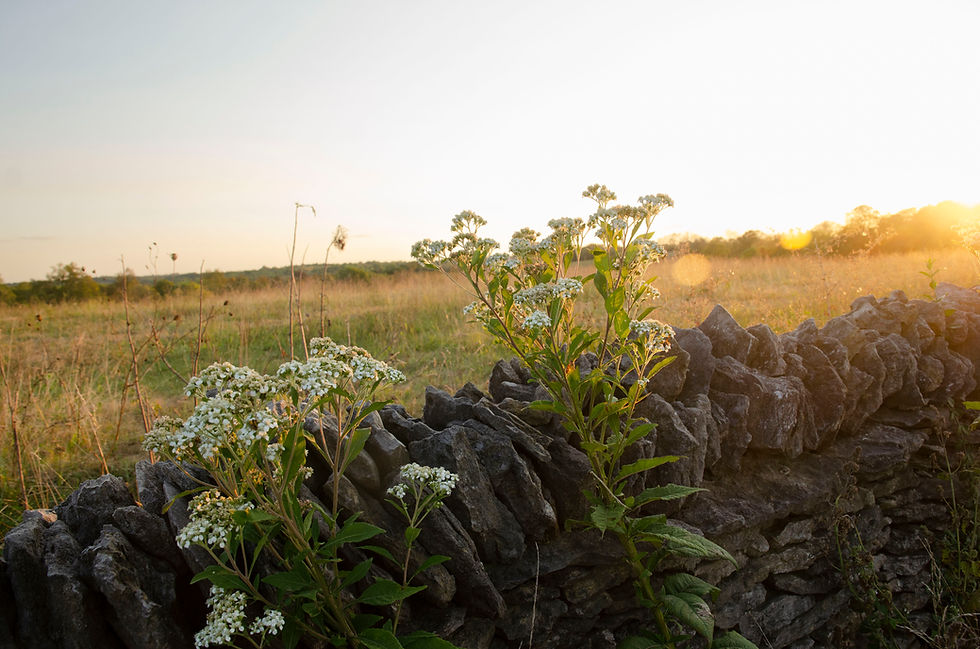
11. Inspect a stone fence.
Directions: Drive down a random Jessamine County country road and find a stone fence.

Stone fences, a signature feature of the Bluegrass landscape, can be found all over Jessamine County. They date back to the 1790s as immigrants from the British Isles brought an open-range tradition with them. Cattle and sheep and pigs were allowed to wander. In fact, a 1798 Kentucky law declared that cattlemen were not liable for damaged crops. Farmers had to build fences if they didn’t want neighboring livestock to destroy them.
Most of the first fences were made of wooden rails. But they rotted easily, and as the timber supply waned over time, wood became expensive. An article in the Southern Planter suggested, “He who has the stone should put them into a fence.” It turned out that there was a lot of stone. Some had to be quarried, and quite a bit was just lying on the surface of sloping fields.
Stone-fence construction really got going in the 1840s. Because they were a big investment, they came to be prized beyond durability. They were cool. The public, writes Carolyn Murray-Wooley, “came to associate the rock fence with wealth, desired social status, and the region’s landed plantation families.” They symbolized “taste, refinement, and a concern for the aesthetic over the mundane.” Lots of plantation owners admired the fences of the English countryside and sought to emulate them.
In fact, that’s where the design dry stone walling came from. Archaeologists have discovered many stone fences buried under the peat in Scotland dating back to the “stone age.” By the 18th century there were many woodland parks with deer and lawns “with low matted green turf and wide-spreading shade-trees above . . . the English fondness for a mansion half hidden with evergreens and creepers and shrubbery, to be approached by a leafy avenue, a secluded gateway . . . a winding stream, an artificial pond, a sunny vineyard, a blooming orchard, a stone wall.”
The best Jessamine County example of this imported English aesthetic was Chaumiere du Prairie. One 1818 visitor said that the owner “has been a good deal in England in his youth, and brought home with him English notions of a country seat . . . Everything is laid out for walking and pleasure. The whole is surrounded by a low, rustic fence of stone.”
So how were these fences made? They dug a 4-6-inch trench. Laid the foundation stones. Used the largest available rocks for this to cover the full width of the foundation. Formed straight lines on the outside edges. The fence itself was usually 24 to 34 inches wide at the base, tapering to 18-20 inches at the cap, or top. The height was about 5 to 5.5 feet tall. Tie-racks were the most important solidifying feature of a fence because they connected the two faces to each other. Says one modern Scottish stonemason on a visit to Jessamine County a couple of decades ago, “Stone should be knitted together from back to front, from side to side and from top to bottom, so the whole is greater than the sum of its parts. Every stone is performing a function. It supports every other stone and it’s locked in the structure.”
Building a stone fence was hard work. A solo mason working at average speed could build just seven feet of dry-laid fence a day. With a helper, he could build 16 feet a day. That said, if a fence was built well, it could last for over 150 years.
Much of the fascination with stone fences centers on who built them. Lots of locals call them “slave fences.” That’s a true story, though not complete.
The origin is actually Irish. According to Murray-Wooley, U.S. census records and the testimony of descendants show that many Irish stonemasons arrived in the early nineteenth century. They designed most of the stone fences in the Bluegrass. That accelerated around the time of the Irish potato famine in the 1840s. By the 1880s they had overseen the construction of most of Jessamine County’s stone fences.
But . . . enslaved people had a critical role. Farm records and Black oral tradition confirm that they comprised a lot of the work force. They dug foundation trenches. They quarried much of the rock and hauled it. During the slack summertime, when the hemp was maturing for about four months, enslavers often compelled their property to work on fences. All for no pay in a brutal system of slavery.
Over time, Black men learned how to build the fences themselves. After emancipation, says Murray-Wooley, they became stonemasons “in their own right.” In fact, the proportion of Black to Irish masons steadily increased into the twentieth century. By 1910 there were two Irish and 16 Black stonemasons in neighboring Woodford County. I don’t have numbers on Jessamine County, but the Prentiss/Prentice brothers were two of them.
Several years ago, I learned how significant stonemasonry—and the Irish-Black relationship—is in local Black memory. I was visiting Macedonia Baptist Church during Black History Month, and Rev. Reginald Davis explained how the experience of working with Irish masons had resulted in his congregation’s love for corned beef and cabbage. At the potluck meal after the service, I got a taste of why!
If memory remains strong, the fences themselves have not. Though built well enough to “last forever,” in the words of one expert, outside conditions intervened. In the twentieth century tree roots and bushes and plants wormed their way between stones and pulled the fences apart. Then as roads were widened by the state, they came under more immediate threat. If owners could not afford to set them back, they often sold the stone to turnpikers, who used round-headed hammers on long springy handles to break up fences into two-inch cubes for the roadbed. Stone fences were further reduced by the transformation of Jessamine farms. Interior fences were removed to make larger, more efficient fields that could be cultivated with mechanized equipment.
A final reason has been suburban development. Contractors purchased many stone fences and then used them to veneer homes. Here’s Murray-Wooley’s explanation: “A contractor buys a fence form a farmer who cannot afford to maintain it. The price offered will allow the farmer to replace the fence with a new woven wire or plank. The contractor gains material that, when sized and fitted, presents a handsome weathered facade. For some homeowners, it is apparently a matter of pride to tell guests (erroneously) that their house was faced with many rods of “slave-built rock fences.”
The result is that 95 percent of the stone fences in the Bluegrass are now gone.
Still, quite a few still line the roads. So much so that it won’t take long to find one as you drive around the county. Some of the best-preserved fences surround the dozens of small, very old graveyards scattered throughout Jessamine.
If you want to learn more, head to the Jessamine County Public Library and check out Carolyn Murray-Wooley and Karl Raitz’s book Rock Fences of the Bluegrass. If you want to learn how to build or repair stone fences yourself, visit https://www.drystone.org/
Sources
Rainsford-Hannay, Frederick. Dry Stone Walling. London: 1957.
Murray-Wooley, Carolyn, and Karl Raitz. Rock Fences of the Bluegrass. Lexington, Ky.: 1992.
“Rock Fences,” Kentucky Encyclopedia, p. 779.
James Lane Allen, The Blue-Grass Region of Kentucky and Other Kentucky Articles. New York: 1892.
Townsend, John Wilson. Kentucky in American Letters, 1784-1912. Cedar Rapids, Ia.: 1913.