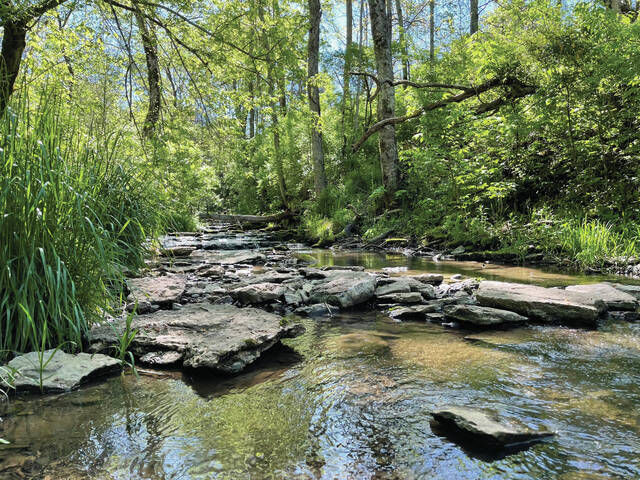
14. Ford Jessamine Creek, literally.
Directions: From Wilmore Elementary School, head east (and down) Campground Lane.

On its nineteen-mile journey to the Kentucky River, Jessamine Creek falls 430 feet past six historic mills and an early nineteenth-century Moravian cemetery. It begins just north of Keene Rd., heads past Wilmore Rd., flows under the R.J. Corman runway, and continues past Short Shun Rd. But just before it goes under the historic Glass Mill Bridge, it passes through—yes, through—Grows Mill Road. That’s where you’ll ford Jessamine Creek.
Like Jessamine County itself, which was carved out of Fayette County in 1798, what Jessamine Creek is named after is disputed. Some say it was named for the Jessamine flower that grew along the banks of the creek, though a leading botany professor at the University of Kentucky says that there’s no way “jasmine could have grown this far to the north abundantly.” Others say it was named for a young settler named Jessamine who was killed by an Indian. That’s probably not true either. What we do know is that Jessamine County is considered the only Kentucky county with a feminine name.
Like its myth of origin, Jessamine Creek’s imagery is ambivalent. On one hand, it has been noted for its beauty. In his 1869 book Moravian Families, historian Samuel Duncan waxed eloquent about the buffalo and deer and bear and panther that roamed the “entangled cane breaks.” He wrote about the hills and cliffs and the series of scenic waterfalls flanked by steep cedar-forested hills. “The stream, where it empties into the Kentucky River, runs smoothly over a solid bed of limestone rock of great depth. As you stand on its border, with rocks rising perpendicularly before you, watching the silvery tide puring [purifying] itself as if it were from the blue bosom of the sky into the depths below, the scene is irresistibly charming.”
Modern scientists agree. They’ve catalogued trees, including red cedar, swamp hickory, Shumard’s red oak, sycamore, wild black cherry, black locust, burning bush, ash-leaved maple, sugar maple, Ohio buckeye, and Carolina buckthorn. And lots of flowers, including pokeweed, bouncing bet, rocket-larkspur, pepper root, whitlow grass, early saxifrage, midland wild senna, and cream violet. And rare plants, including water stitchwort, synandra, mountain lover, snow trillium, cleft phlox, false melic grass, and field mouse-eared chickweed. And animals, including 25 species of mammals and 36 species of reptiles and amphibians. There are two caves that harbor a Gray Bat maternity site and the Indiana Bat, both globally listed endangered species. Jessamine Creek Gorge has been identified as one of the ten most environmentally significant areas in the state of Kentucky.
It’s no wonder that locals have loved hanging out at Jessamine Creek. In the 1990s old-timer Buck West remembered, “I was born October 3, 1910, in a log cabin on the banks of beautiful Jessamine Creek. I liked to explore the creek, hunting ol’ crawfish, small snakes and go-devils, and just about anything that lived in the water.” A 1905 article in the Jessamine Journal described how boys growing up on the creek enjoyed “fishing, hunting and despoiling bird’s nests.” An 1887 article told the story of Mrs. Corman who pulled up, three times in succession, six fishes with two hooks attached to her fishing line. The aggregate weight of the fish was thirteen pounds.
My favorite article describes a beautiful scene of community along the creek in 1887. The Bethany Fishing Club hosted an annual fish fry in a beautiful and romantic woodland. “Quite a nice crowd assembled early,” read the article, “and seemed to feel the exhilarating influence of the fresh morning air, the beautiful surroundings, and the communing of friends and neighbors.” Horse shoe pitching was the “afternoon amusement.” The fish were prepared by J. A. Nave and W. G. Robinson, whom “all united in praising since they are marriageable men, and with the above recommendations we feel assured they will be sought after.” Delightful, right?
On the other hand, there’s a lot of violent, macabre imagery associated with Jessamine Creek. A writer in the late-nineteenth century wrote, “Unlike its flowery name, the stream is symbolical with blood—its history is written in blood, the red, dark blood of the murdered, the cold blood of the suicide, and the hot, passionate blood of the foeman.” Consider all these versions of the Jessamine Douglas legend:
-
“The beautiful daughter of a Scottish settler was one day sitting on the bank of the creek and while in maidenly contemplation, gazing into the depths of the water, an Indian cautiously and silent stole upon her and sunk his tomahawk into her head and then tore her beautiful auburn locks from her head with his scalping knife.”
-
“At twilight one summer afternoon Jessamine was found dead by her lover, Leroy Jameson, laying face downward in the shallow water of the stream. A stone seat which they had arranged in this shady nook was the accustomed meeting place of these sweethearts each evening.”
-
“The beautiful love-lorn Jessamine was sitting pensively on the banks of this lovely stream, thinking of her lover and of the braes and banks of bonnie Scotland she was never more to see, when a fiendish Indian stealthily knelt behind her and buried his tomahawk in her skull. The father, broken-hearted and hopeless, returned to his native land, leaving no descendants here.”
-
“The story of true love whose course did not run smooth with the fair Jessamine Douglas ended in melancholia and suicide in the beautiful creek which was named after her. Her father was one of the earliest settlers.”
That’s not all. Among the very many other accounts of murders and accidents and suicides, here are just a few:
-
1804: “A number of young men had assembled one afternoon to engage in foot races and wrestling contests. Samuel Clay, an uncle of the noted Cassius Clay, abolitionist, duelist, and Minister of Russia, was killed by James Rice. Clay had defeated Rice in a foot race and then slapped him in the face, whereupon Rice shot him. It was the first killing of one white man by another after the county had been named.”
-
1826: “Henry Worden, a young man, attempted to ford the creek during the early spring while the waters were swift and high. He is said to have been intoxicated and was drowned in the muddy waters near the mouth of the creek.”
-
1840: “During the forties, Pete Nave, who lived in a cabin which stood on the banks of the stream opposite the handsome house of Louis and John Brown of the present day, was murdered in his sleep. The perpetrator of the crime was never known.”
-
1858: “A peculiar killing occurred at Glass’ Mill. There is a dam in the creek at the mill which forms a deep pool of water. “Big Bill” Hall, a white man, and a Negro went in bathing there one afternoon and while undressed became involved in a difficulty. Hall grabbed a large stone and hurling it with terrific force at the Negro, struck him over the heart, crushing his ribs and causing instantaneous death.”
Pollution has also tarnished Jessamine Creek. Prior to the 1960s, there were no zoning regulations in the county. And lots of trash was dumped in the creek. Consider this October 22, 1970, article:
“Below each riffle were patches of foam—probably the remainder of laundry and kitchen detergents from many homes. . . . We encountered a Lexington pastor with several disadvantaged city boys. They were exuberant in their frolicking, enjoying their autumn outing. They had brought soft drink in disposable bottles and were taking a ‘thirst break’ when we met them. Later, hearing the crash of a breaking bottle, I went back to talk with the minister about it. He said that he was trying to get the boys to put all of the bottles together in one out-of-the-way spot, but he didn’t see anything wrong with leaving them there. ‘After all,’ he commented, ‘they cause pollution at the city dump too! Why carry them back?’”
Sewage was a problem too. Since the 1930s both Nicholasville and Wilmore had been discharging effluent from their sewage treatment plants into the creek. And in the early 1990s it looked like it could get worse. Nicholasville was one of the fastest growing communities in Kentucky and was quickly outgrowing the sewage treatment plant installed in 1983. A secondary treatment plant on Jessamine Station Rd. near Jessamine Creek was proposed which would separate “85 percent of the solids from the liquids and dump the rest in the creek.” The county liked the site because it would be substantially less expensive. But critics said putting it there would “reduce Jessamine Creek to nothing more than a sewer drainage ditch.” One asked, “Will elected officials give Jessamine Creek ‘the royal flush?”
The controversy finally ended in March 1994. The city settled a lawsuit with Friends of Jessamine Creek and agreed to purchase land at 2298 Shun Rd., an address quite a ways from Jessamine Creek. The plant was up and running in March 1998 and treated nine million gallons of wastewater a day.
If you want to see the Jessamine Gorge for yourself, take Corman Lane one mile south from Bethel Road. Enjoy the hike!